

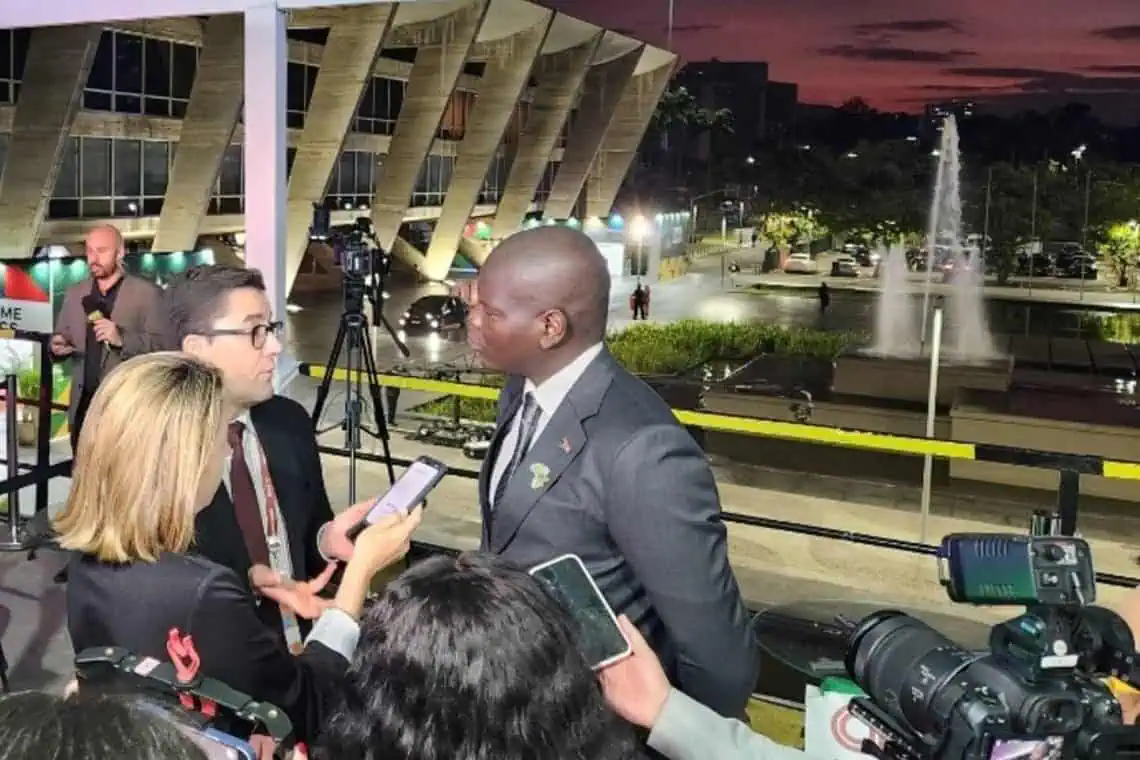

In a firm declaration of national independence, South Africa’s Foreign Minister Ronald Lamola has rejected U.S. accusations of racism against white citizens, asserting that Pretoria will resist foreign interference in its equity-driven race policies. This stance follows the United States’ confirmation of South Africa’s exclusion from the 2026 G20 summit during its presidency, a decision that underscores the nadir of relations between the two nations. In retaliation, President Cyril Ramaphosa’s government has declared a deliberate “commercial break” from U.S.-chaired G20 proceedings, hinting at a broader realignment in international partnerships and casting uncertainty over the $20 billion annual U.S.-South Africa trade lifeline.
Igniting the Fuse: Trump’s Allegations and the G20 Boycott
The discord intensified during South Africa’s landmark 2025 G20 presidency—the inaugural for an African host—convened in Johannesburg from November 22-23. U.S. President Donald Trump opted out of the gathering, invoking debunked narratives of a “white genocide” against Afrikaner farmers via land expropriations and assaults. These assertions, echoed by Trump supporters like Elon Musk, cast South Africa’s Black Economic Empowerment (BEE) initiatives and land reform programs as discriminatory reprisals, glossing over apartheid’s enduring legacy that marginalized the Black majority for generations.
Trump’s boycott transcended symbolism, evolving into a diplomatic impasse. As outgoing host, Ramaphosa was poised to transfer the symbolic gavel to the U.S. representative. Washington suggested delegating this to a low-level embassy staffer, a proposal South Africa dismissed as undignified. In reprisal, Trump proclaimed on Truth Social that South Africa was unfit for the 2026 G20 at his Doral resort in Miami, denouncing the country as “not worthy of membership anywhere” and instantly suspending U.S. financial support.
Secretary of State Marco Rubio amplified the rhetoric, charging Pretoria with “weaponizing” the G20 through a “DEI agenda” emphasizing diversity, equity, and inclusion—elements the U.S. deems extraneous to economic priorities. Rubio’s critique mirrored Trump’s May 2025 Oval Office confrontation with Ramaphosa, where footage allegedly depicting farmer murders was screened—evidence Ramaphosa refuted immediately, clarifying that violence impacts all demographics proportionally and no systematic land grabs have ensued.
Lamola’s Resolute Address: Unraveling the ‘Racism’ Myth
On December 4, 2025, Foreign Minister Ronald Lamola issued a blistering address from Johannesburg, portraying U.S. rebukes as duplicitous standards steeped in white supremacist undertones. In an open letter to Rubio, Lamola stated: “Our policies of redress are not a political invention. They are the fulfilment of a promise made to all South Africans as we emerged from the darkness of apartheid.” He condemned the U.S. for fast-tracking white Afrikaner refugees while overlooking pervasive violence in Black townships, deeming it a “manifestation of white supremacy.”
Lamola’s critique extends the legacy of his predecessor, Naledi Pandor, who branded Trump’s rhetoric as apartheid apologia. Pandor, now leading the Nelson Mandela Foundation, saw her U.S. visa revoked in November 2025 amid the fraying ties. Lamola affirmed that BEE and the 2025 Expropriation Act—permitting land acquisition solely for public benefit under equitable terms, without racial targeting—represent constitutional mandates for fairness, not retribution. Global fact-checkers, from Reuters to the BBC, have consistently refuted the “genocide” myth as far-right disinformation.
“Secretary Rubio, the world is watching. It is growing weary of double standards,” Lamola proclaimed, affirming South Africa’s willingness for discourse but rejecting any quest for “approval for our path.” Ramaphosa mirrored this resolve, terming the exclusion “regrettable” yet pinning it on “misinformation and distortions.” A presidential aide revealed the “commercial break” from 2026 G20 engagements, a self-imposed hiatus to evade indignity, with full reentry slated for the UK’s 2027 stewardship.
Historical Underpinnings: Apartheid’s Legacy and Policies in the Crosshairs
To comprehend the fervor, one must confront apartheid’s indelible wounds. From 1948 to 1994, the National Party’s regime institutionalized racial apartheid, allocating 87% of arable land to whites—who formed merely 10% of the populace—while enforcing draconian segregation that stifled Black advancement. Since 1994, the African National Congress (ANC) has pursued restorative actions: BEE enforces equity stakes in enterprises, while affirmative action bolsters Black hiring to erode entrenched disparities. The 2024 Expropriation Act empowers state intervention for communal needs, yet its rollout is measured; no mass dispossessions have transpired.
Trump’s storyline flips this chronicle, equating it to “reverse apartheid” and prioritizing Afrikaner asylum—a stance Lamola assailed as prejudicial, neglecting South Africa’s 30 million impoverished Black citizens amid escalating criminality. Detractors posit this narrative bolsters U.S. internal politics, courting white nationalist bases while evading America’s racial fissures, as spotlighted by the George Floyd uprisings and beyond. Yet, data underscores the policies’ intent: BEE has elevated Black managerial representation from 10% in 1994 to over 35% today, per the Commission for Employment Equity, fostering broader economic inclusion despite implementation flaws.
Moreover, the Expropriation Act aligns with global norms, mirroring eminent domain laws in the U.S. and elsewhere, where public utility trumps private holdings without racial animus. International observers, including the Amnesty International, affirm its safeguards against abuse, countering hyperbolic claims of “seizure” that ignore judicial oversight and compensation provisions. This historical redress remains pivotal, as apartheid’s economic distortions persist: Black South Africans hold just 4% of JSE-listed firm shares, per 2024 Beresford reports, justifying sustained intervention.
Economic Ripples: Trade Disruptions and Strategic Shifts
The standoff endangers a vital $20 billion trade artery, with the U.S. ranking as South Africa’s second-largest partner post-China. In March 2025, Washington ousted Pretoria’s envoy and levied 30% duties on sectors like automobiles and agriculture—penalties South Africa contests at the World Trade Organization (WTO). The G20 ouster compounds perils: South Africa forfeits a vital arena for pressing debt alleviation and climate funding, indispensable for its coal-reliant economy’s green pivot.
Experts foresee a G20 schism along North-South lines, with rising economies like India and Brazil—prior hosts—poised as conciliators. Rubio’s “New G20” courts Poland as a substitute, lauding its ascent while excoriating South Africa’s “redistributionist policies that discouraged investment.” Nevertheless, Pretoria pursues diversification: fortifying BRICS bonds, amplifying intra-African commerce through the African Continental Free Trade Area (AfCFTA), and deepening EU and Chinese collaborations to cushion U.S. shortfalls. The AfCFTA, launched in 2021, has already boosted regional exports by 15% in 2024, per African Union data, offering a buffer against unilateral sanctions.
Ramaphosa’s circle portrays the “break” as liberating, redirecting energies toward Global South cohesion. As Lamola observed post-summit, “The G20 should send a clear message that the world can move on with or without the U.S.” Brazilian leader Luiz Inácio Lula da Silva agreed, dismissing Trump’s absence as immaterial to multilateralism’s endurance. This pivot echoes South Africa’s BRICS expansion in 2024, integrating Egypt, Ethiopia, Iran, and the UAE, which has unlocked $10 billion in new investments, mitigating tariff shocks.
Beyond immediate trade hits, the tariffs exacerbate South Africa’s fiscal strains. The 30% levy on autos alone imperils 150,000 jobs in the sector, which contributes 7% to GDP, according to the Automotive Industry Development Centre. Yet, adaptive measures abound: the dtic’s Export Marketing and Investment Assistance scheme has surged applications by 20% since August, channeling firms toward Asia and Europe. WTO filings, too, gain traction; a 2025 panel ruled analogous U.S. duties on India violative, bolstering South Africa’s case.
Global South Solidarity: Forging New Alliances
The snub catalyzes South Africa’s embrace of multipolar diplomacy. Enhanced BRICS engagement promises infrastructure infusions, with China’s $5 billion Belt and Road commitments targeting renewables. The EU’s Global Gateway initiative, pledging €150 billion continent-wide, prioritizes South Africa for green hydrogen hubs, offsetting U.S. aid cuts totaling $500 million annually in health and education grants.
Intra-African ties flourish too: AfCFTA’s tariff eliminations have tripled non-mineral exports since 2023, per UNCTAD, fostering value chains in agro-processing and textiles. Lula’s endorsement at the Johannesburg summit—where 18 members backed the climate and gender declaration despite U.S. dissent—signals budding coalitions. Indian Premier Narendra Modi’s bilateral pacts on digital trade further insulate against isolation.
Future Horizons: Multilateralism’s Litmus Test
Despite the boycott, South Africa’s G20 stewardship birthed a communiqué on climate resilience and gender parity—achievements Rubio scorned but which secured 18 nations’ acclaim. Lamola’s posture reaffirms Pretoria’s ubuntu ethos against unilateral dictates, prodding the U.S. to reconcile its hypocrisies.
As 2026 approaches, this deadlock probes the G20’s fortitude. Might Trump’s “New G20” marginalize Washington, or compel equity reckoning in global arenas? For South Africa, it marks a resolute arc in reconstruction, validating post-apartheid equity against hegemon slights. Lamola’s closing: the globe observes not for sanction, but for equity’s triumph.
This episode illuminates broader geopolitical flux. With 55% of Global South nations backing South Africa’s ICJ Israel case per 2025 Pew surveys, Pretoria emerges as a redress vanguard. Domestically, BEE refinements—targeting elite capture via community trusts—could amplify efficacy, as piloted in Sasol’s Inzalo model benefiting 200,000 workers. Ultimately, resilience defines South Africa’s trajectory: from apartheid’s ashes, a sovereign voice endures, undeterred by distant tempests.