

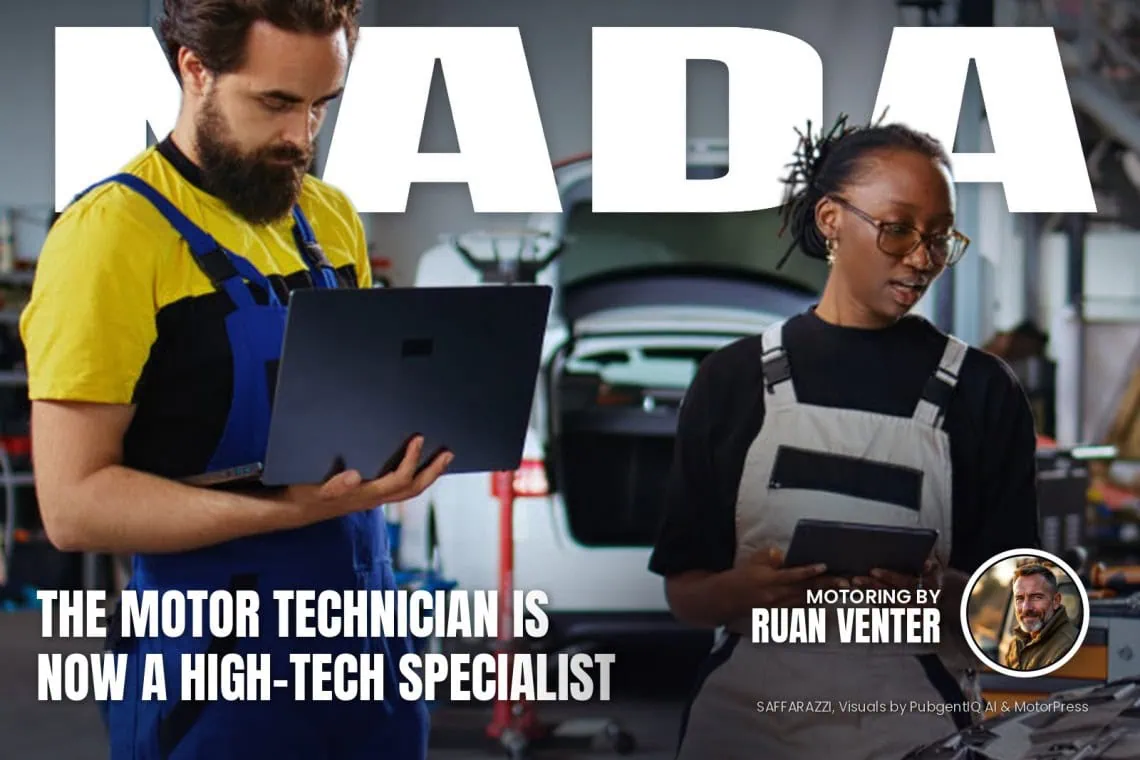

- NADA highlights changing role of motor technicians.
- Modern cars carry 30 to 80 computer modules.
- Some NEVs feature well over 100 to 200 ECUs.
- South Africa faces scarcity of qualified technicians.
- Motoring Mavericks initiative targets trade stigma.
The National Automotive Dealers’ Association (NADA) has called for a rethink of how the automotive technician’s trade is viewed, saying the job has shifted from spanners and grease to diagnostic data and software.
“Today’s automotive technicians spend as much time analysing diagnostic data on high-powered laptops and tablets as they do turning a spanner,” said NADA chairperson Brandon Cohen. In his view, vehicles have evolved from purely mechanical machines into complex computers on wheels.
From carburettors to computer modules
Cars built before the 1980s relied entirely on mechanical systems. Fuel-to-air mixtures were adjusted by hand through carburettors, ignition timing was set by breaker points, and even wipers and door locks ran through analogue switches and vacuum lines.
Early emission regulations in the 1980s and 1990s brought the first Engine Control Units, with a single low-powered processor managing basic fuel injection and spark timing. In the 2000s and 2010s, separate modules followed for anti-lock brakes, airbags and automatic transmissions, linked by internal wiring networks.
Today a typical car has between 30 and 80 computer modules. Flagship models, luxury vehicles and New Energy Vehicles can feature well over 100 to 200 ECUs, governing driver assistance systems, radar and camera modules, over-the-air software updates and battery management.
The role of the master technician
With combustion engines, hybrid systems, high-voltage batteries and software networks now working together, Cohen compared the master technician to a medical specialist in the duration, intensity and continuous learning the work demands. Such a technician, he said, is part mechanical engineer, part software analyst and part electronics expert.
Technician shortage in South Africa
Despite that complexity, South Africa faces a growing scarcity of qualified automotive technicians. Cohen pointed to the stigma around technical trades as a key barrier, contrasting it with Germany and Switzerland, where artisans are held in high esteem.
Through initiatives such as NADA’s Motoring Mavericks, the retail motor sector aims to change that perception. The association says qualified technicians who understand ECU diagnostics and high-voltage systems are among the most sought-after professionals in the country, and that the work spans combustion, hybrid and full electric vehicles, with ongoing upskilling as connected, autonomous and electric technology advances. “It’s time to rethink the trade,” said Cohen.
Supplied by MotorPress (Ilana Salant, Media Contact, Meropa Communications)
This story is based on aggregated news, press release(s) or other sources and was prepared with the help of AI tools, which can make mistakes. Prices, specifications, general information and availability may change, so confirm the details with the manufacturer, other news sources or a dealer.