

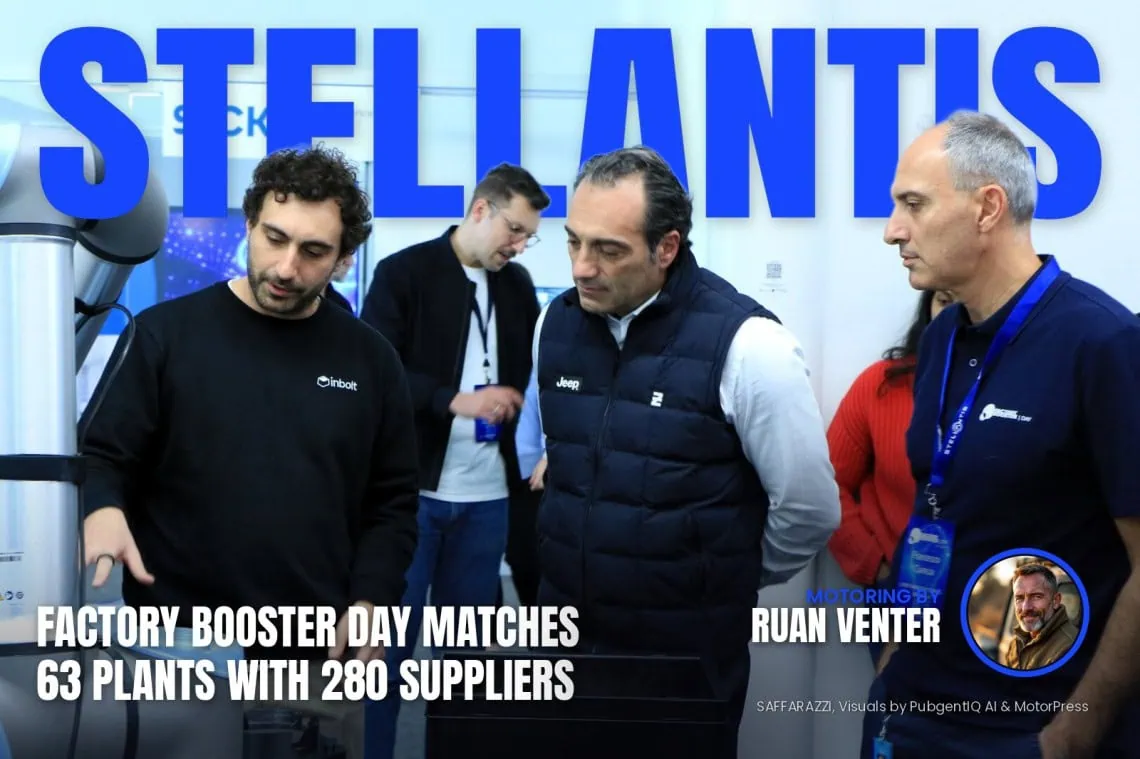

- Factory Booster Day 2026 held on October 21.
- Challenges submitted from 63 Stellantis plants.
- More than 280 suppliers and startups responded.
- Over 80 selected to present solutions.
- Annual event running since 2016.
Held on October 21, the 2026 edition of Factory Booster Day brought together plant teams from Stellantis and outside technology firms. The annual event links real operational problems in the group’s factories with solutions put forward by suppliers and startups, with the aim of improving manufacturing performance, quality and competitiveness.
How the Factory Booster Day process works
Since it began in 2016, the programme has used an Open Challenge process. Plant teams describe real-world operational needs, and suppliers and startups propose tailored answers. Selected projects target quality, efficiency, safety and sustainability on the shop floor, and those that succeed are prepared for implementation across Stellantis plants.
This year, challenges came from 63 plants across all regions. In response, more than 280 suppliers and startups submitted ideas covering AI, automation, advanced robotics, vision systems, energy intelligence and digital manufacturing, and over 80 of them were chosen to present at the event.
Stellantis manufacturing chief on collaboration
Francesco Ciancia, Chief Manufacturing Officer at Stellantis, said the approach starts from real plant challenges and focuses on solutions that can be deployed at scale, “accelerating innovation where it matters most: on the shop floor.”
The agenda also added Beyond the Booths, a series of spotlight sessions in which company leaders discussed key manufacturing priorities. Alongside it, the Innovation Global Awards recognised contributions from employees and plants across the regions, with winning projects judged on technical work and measurable operational impact.
Past projects in the United States, Spain and France
Earlier editions show how the scheme supports the group’s FaSTLAne 2030 strategic plan. At the Sterling Stamping plant in Michigan, ThinkDigits, a Michigan-based industrial AI company, introduced real-time blank draw-in monitoring to spot stamping deviations earlier. Annual savings came to nearly four times the initial investment, supporting expansion to further production lines.
In Spain, ZEISS brought fixtureless geometry measurement for stamped parts to the Zaragoza plant, removing the need for dedicated checking fixtures at a low implementation cost. At Sochaux in France, Uptale built immersive digital training modules and virtual production-line tours to replace paper-based instruction and widen remote access to manufacturing processes. Successful solutions from this year’s event will follow the same route towards implementation across Stellantis plants.
Supplied by MotorPress (Sizwekazi Mdingi, Media Contact, Stellantis)
This story is based on aggregated news, press release(s) or other sources and was prepared with the help of AI tools, which can make mistakes. Prices, specifications, general information and availability may change, so confirm the details with the manufacturer, other news sources or a dealer.