

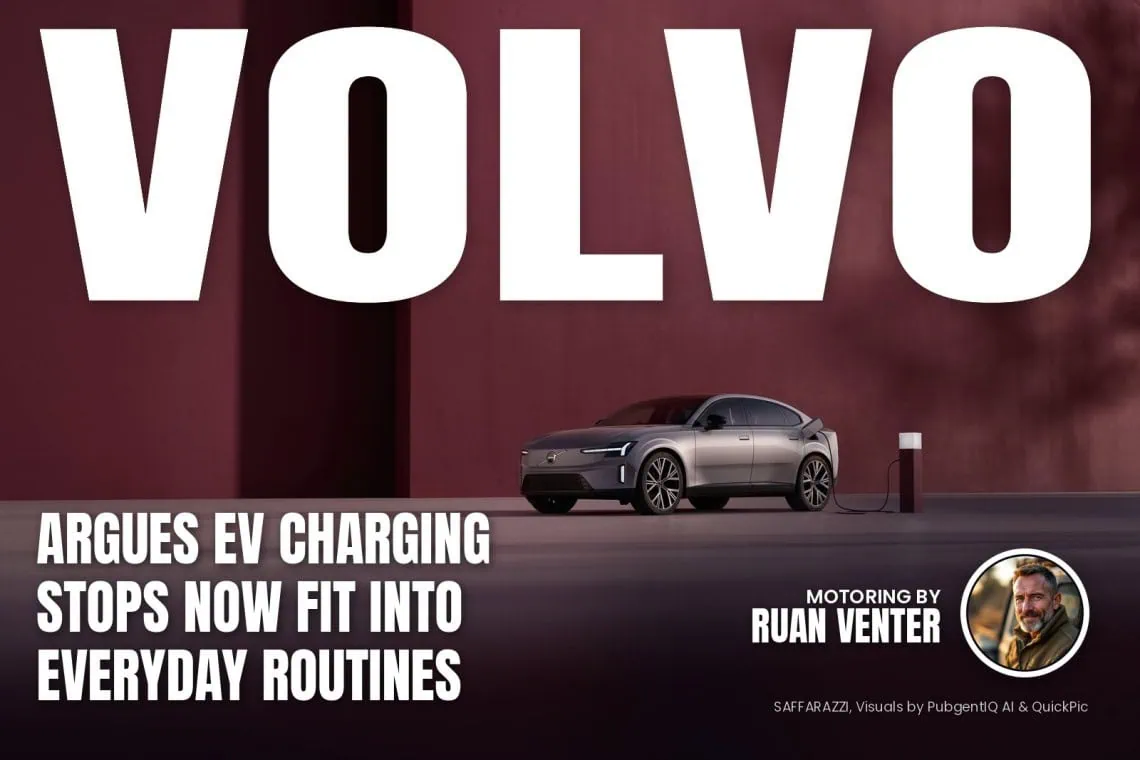

- N3 hubs doubling to 720kW each.
- Upgrade announced in August.
- Typical fast charge takes about 30 minutes.
- ES90 charges 10 to 80% in 22 minutes.
- EX30 takes about 26 minutes at 175kW.
Zero Carbon Charge announced in August that it would double the capacity at its two charging hubs on the N3, taking each from 360kW to as much as 720kW. The hubs had been open for only three months, and the upgrade was brought forward because more drivers were using them than the company had planned for.
For several years, talk about electric vehicles in South Africa has circled one worry: whether the infrastructure would arrive. According to Volvo, it is arriving and in places it is being outpaced, which shifts the question to what drivers do while they wait.
What drivers do during a charge
A typical stop on a fast public charger runs to roughly half an hour, depending on the car. That is long enough for a grocery shop, a coffee, a school pickup or a round of emails. At the N3 hubs, the stop includes a farm stall, a restroom and free WiFi.
“Half an hour is not a long time. On a long journey, it passes while you’re still in the queue buying chips,” says Grant Locke, Managing Director of Volvo Car South Africa. He adds that charging is “a quick pit stop while you go on with your day.”
Volvo ES90 and EX30 charging times
Exact times depend on the vehicle and the charger. Built on an 800-volt system, the ES90 is quoted at 10 to 80% in around 22 minutes, though that assumes a 350kW charger. The smaller EX30 takes closer to 26 minutes on a 175kW unit. On the 75kW chargers common in many shopping malls, most cars need half an hour or more.
Where South African chargers are found
More stations in South Africa are appearing where people already spend time, such as shopping centres, office parks and restaurants. In Johannesburg, Cape Town and Durban, a driver can generally find one within about 20 kilometres.
Public charging is also the smaller part of the picture. Most charging happens at home, overnight, at the lowest tariff available. The public network serves as a top-up while motorists are already out, so its location matters more than its speed.
Limits that remain for EV owners
None of this makes electric ownership frictionless. Charger availability still varies, and long trips need more planning than a tank of petrol. Still, with petrol prices rising, the argument is that treating every charge as thirty minutes lost assumes that time was otherwise free, when for most drivers it was already spoken for by an errand, a coffee or a pickup.
Supplied by QuickPic (Volvo Car)
This story is based on aggregated news, press release(s) or other sources and was prepared with the help of AI tools, which can make mistakes. Prices, specifications, general information and availability may change, so confirm the details with the manufacturer, other news sources or a dealer.