

- Euro NCAP introduces revised 2026 test protocols.
- Biggest testing revision in three years.
- Four stages, from safe driving to post-crash care.
- Volvo standard built on 50,000-plus real accidents.
- Research spans more than five decades.
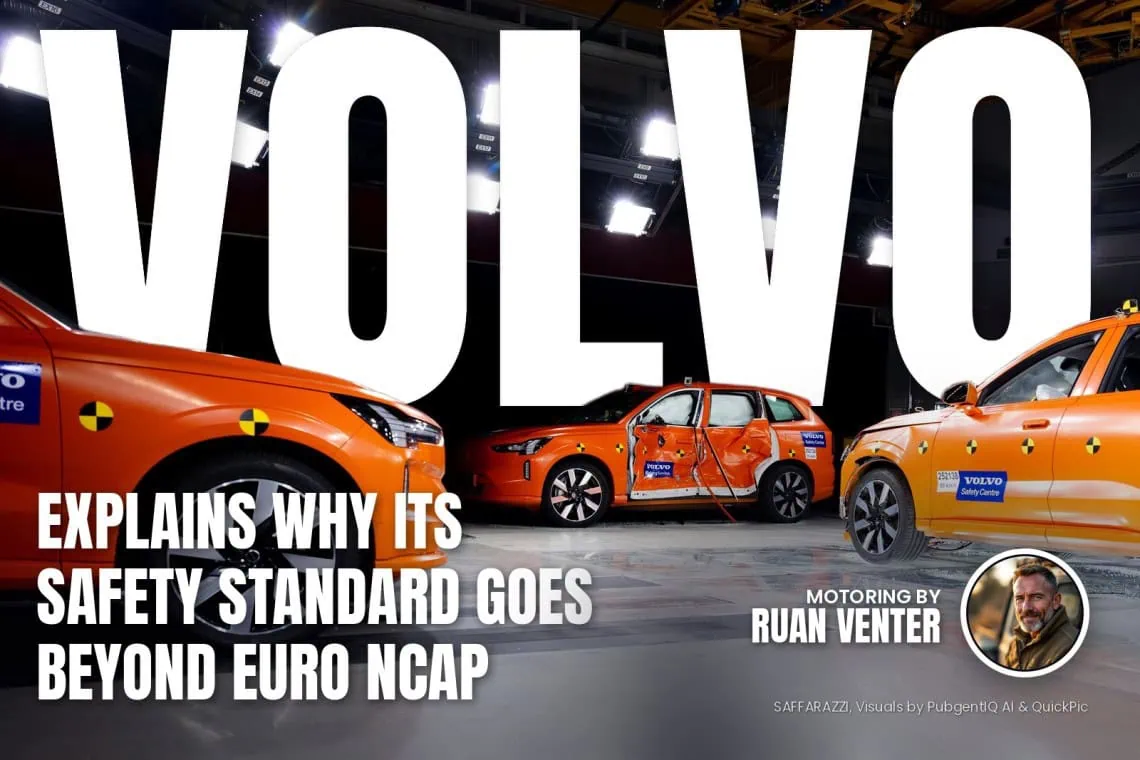
Euro NCAP has overhauled the way it assesses new cars, and Volvo has used the change to explain why it keeps working to requirements above those of official testing. The 2026 protocols, the biggest revision in three years, are structured around four stages, namely safe driving, crash avoidance, crash protection and post-crash care.
Frontal impact testing now considers a wider range of body types, including older occupants and children, instead of assuming a single standard adult. For most of the past two decades the industry treated the crash test as the finish line. According to Volvo, the new rules move closer to the approach its engineers have followed for years, which judges a car by how it behaves in the situations people drive into rather than only in a controlled impact.
How the Volvo Cars Safety Standard works
The company keeps its own internal benchmark, the Volvo Cars Safety Standard, which sets requirements above what official testing asks for. It draws on crash research covering more than 50,000 real accidents involving over 80,000 people, gathered over more than five decades. When a vehicle is designed around a particular seat position, occupant size or type of collision, that decision usually traces back to a file in this database rather than to a regulation.
“A test protocol has to be repeatable, which means it has to be simplified,” says Vusi Machie, Product and Pricing Manager at Volvo Car South Africa. “Real roads are not simplified.”
Real roads versus crash test conditions
That difference shows up in ordinary ways. Occupants come in different sizes and sit in different positions, and collisions happen at intersections and in car parks as often as they happen head-on. Much of what protects people now works before impact, through braking, steering support and sensors that read the road, and none of it is visible in a star rating.
Recalls and ongoing Volvo safety research
The carmaker acknowledges it is not infallible. Complex vehicles develop faults, and when they do, the responsibility is to identify them quickly and fix them properly, which is the purpose of the recall process. “The standard is never finished,” Machie says. “Every accident we study tells us something the previous ones did not.”
Independent testing still matters, and the 2026 protocols give it greater weight. In Volvo’s view, the measure of a manufacturer is what it does in the space the test cannot reach.
Supplied by QuickPic (Volvo Car)
This story is based on aggregated news, press release(s) or other sources and was prepared with the help of AI tools, which can make mistakes. Prices, specifications, general information and availability may change, so confirm the details with the manufacturer, other news sources or a dealer.
Enjoyed this story? We need your help.
Add Saffarazzi as a preferred source. You’ll see more of our stories on Google, and you’ll help us grow.