

- 1,503 animal-related injury collisions over five years.
- 1,939 people injured or killed, 2021 to 2025.
- 79% occurred on rural roads.
- 54% happened in darkness.
- 28% classed as fatal or serious.
Analysis of Department for Transport figures by Volvo Car UK has identified 1,503 police-recorded injury collisions involving animals on roads in Great Britain between 2021 and 2025, leaving 1,939 people injured or killed. The findings come ahead of the clocks going back, when drivers in Great Britain are more likely to meet wildlife in the dark.
Of those collisions, 54% happened in darkness, compared with 28% of all reported injury collisions. Almost four in five (79%) were on rural roads, and 28% were classed as fatal or serious.
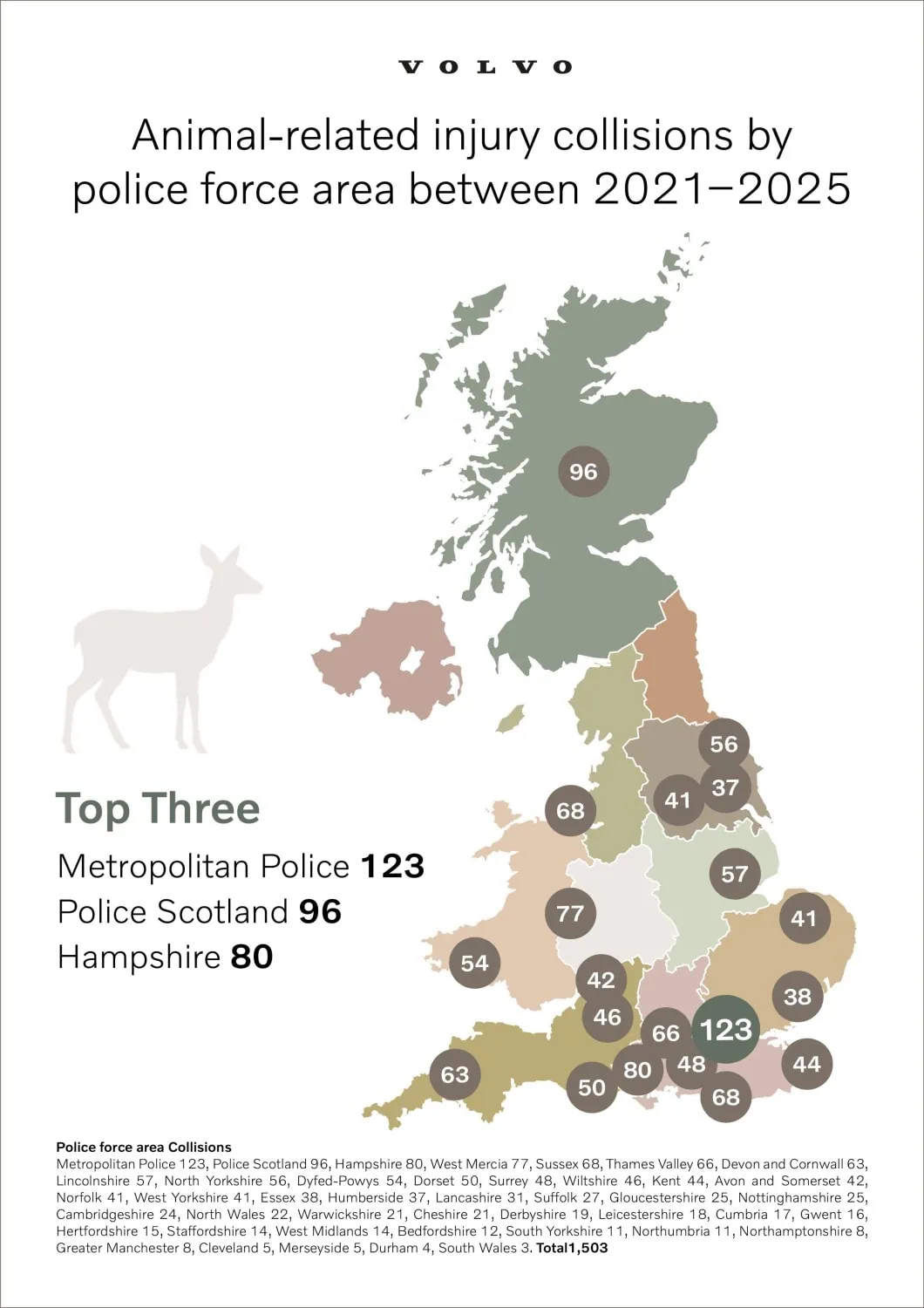
Where animal collisions in Great Britain occur
The Metropolitan Police recorded the most animal-related injury collisions over the period, with 123, followed by Police Scotland with 96 and Hampshire with 80. West Mercia logged 77, Sussex 68 and Thames Valley 66.
Regionally, the South East led with 306 collisions, ahead of the South West on 226 and the East of England on 157. Together, the two southern regions accounted for 35% of the total.
Months and hours with the most collisions
August recorded the highest monthly total across the five years, with 157 collisions, followed by October with 151 and November with 141. Almost three in 10 crashes occurred between 7pm and midnight, and 9pm was the single worst hour.
Because the figures cover only police-recorded injury collisions, the real number of animal strikes is likely to be far higher. The British Deer Society estimates that more than 40,000 deer are killed or injured on UK roads each year, possibly as many as 74,000.
Volvo Large Animal Detection and moose testing
The carmaker has studied large-animal collisions since the 1980s. At its Safety Centre in Gothenburg, engineers use a 360 kg moose crash-test dummy, one of only two in the world. Its Large Animal Detection system, introduced in 2016, uses exterior sensors and algorithms to spot large animals, warn the driver and brake automatically if needed, while Connected Safety lets compatible cars share hazard information through the cloud.
Nicole Melillo Shaw, Managing Director of Volvo Car UK, said animals “can appear with little warning” and that “staying alert and adapting your speed to the conditions remain essential, especially on darker winter journeys.” The full data set is available from the government’s road safety open data pages.
Supplied by Newspress UK (Volvo)
This story is based on aggregated news, press release(s) or other sources and was prepared with the help of AI tools, which can make mistakes. Prices, specifications, general information and availability may change, so confirm the details with the manufacturer, other news sources or a dealer.