

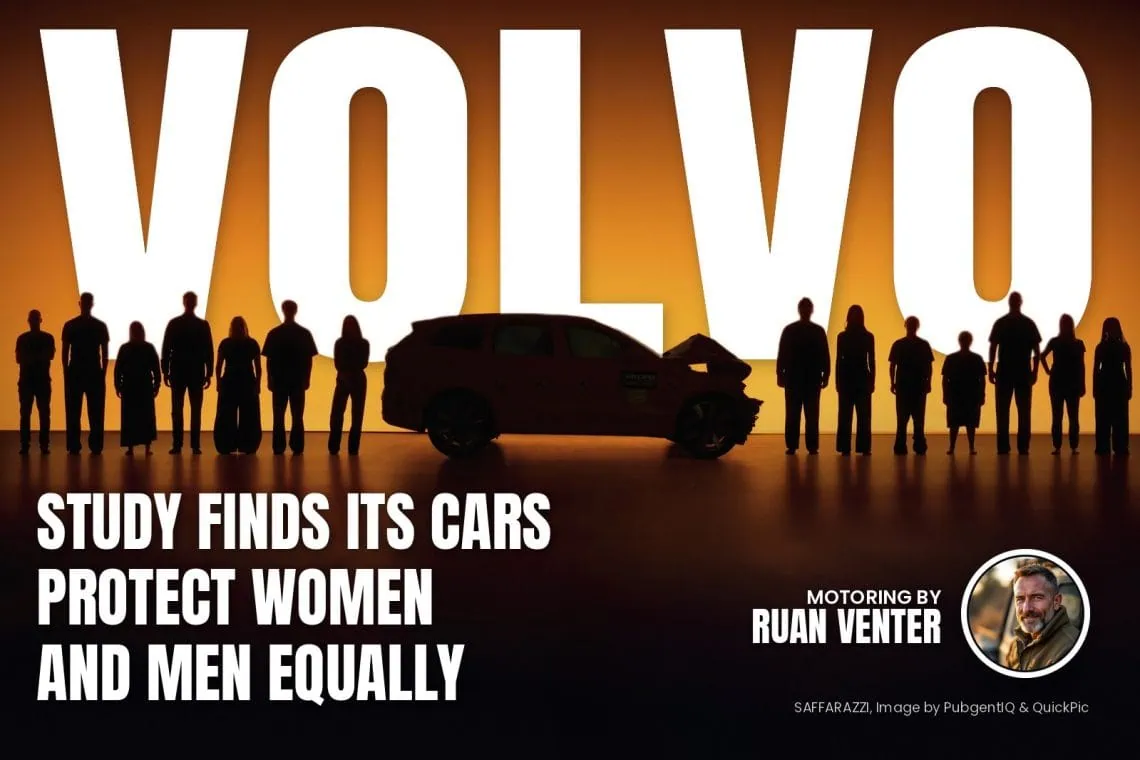

- Volvo study covers five decades of crashes.
- Driver injury risk down 79 per cent.
- Injury risk for women down 88 per cent.
- Data from over 50,000 real-world crashes.
- Published at ESV International Conference 2026.
Volvo Cars has published a report based on decades of research which shows that its cars have protected women and men equally since the 1970s. The research, conducted by Volvo Cars Safety Centre, challenges the long-standing assumption that cars are inherently not equally safe for women and men.
The report describes how the company has advanced protection for occupants over five decades, using data from real-world accidents to guide safety development.
Volvo injury risk figures for women and men
Comparing Volvo car models from 2010 to 2019 with models from 1970 to 1979, overall injury risk for drivers has decreased by 79 per cent. For women, the reduction is 88 per cent, which brings their injury risk to the same level as that of men.
The results also show that restrained rear-seat occupants in Volvo cars have protection levels comparable to, and in some cases exceeding, those of front-seat occupants. This comes despite a lack of stringent regulatory requirements and standardised testing for the rear seat over the years.
“By studying real-world crashes and designing with the needs of women, men and children of all body types in mind, we’ve worked for decades to provide a high level of protection regardless of who you are or where you sit in the car,” said Åsa Haglund, head of Volvo Cars Safety Centre.
Volvo crash data and safety standard
Since 1970, Volvo Cars has collected data from over 50,000 real-world crashes involving over 80,000 occupants. Through its Circle of Life approach, these findings feed into safety requirements, testing, vehicle development, verification and production. The data also underpins the Volvo Cars Safety Standard, the company’s own benchmark, which covers a wider range of crash scenarios across all seating positions than regulations or safety ratings require. Its research considers occupant gender, height, body shape and weight rather than standardised crash test dummies alone.
How the Volvo study was conducted
The study was led by Lotta Jakobsson, Ph.D. Eng. and Thomas Broberg, Ph.Lic. Eng. at Volvo Cars Safety Centre, and was published as part of the Enhance Safety of Vehicle (ESV) International Conference 2026. It analyses frontal, side and rear-end impacts, run-off-road accidents, rollovers, side-swipe collisions, large animal impacts and multi-collision crashes. It focuses on belted occupants aged 13 and older and examines injuries such as fractures and concussions, excluding minor injuries such as bruises and pain.
Volvo safety research access
Through the Equal Vehicles for All (E.V.A.) Initiative, launched in 2019, more than 50 years of Volvo Cars safety research is freely available in a digital library for other carmakers, researchers and policymakers. The full report is available from Volvo Cars.
Supplied by QuickPic (Volvo Car)
This story is based on aggregated news, press release(s) or other sources and was prepared with the help of AI tools, which can make mistakes. Prices, specifications, general information and availability may change, so confirm the details with the manufacturer, other news sources or a dealer.