

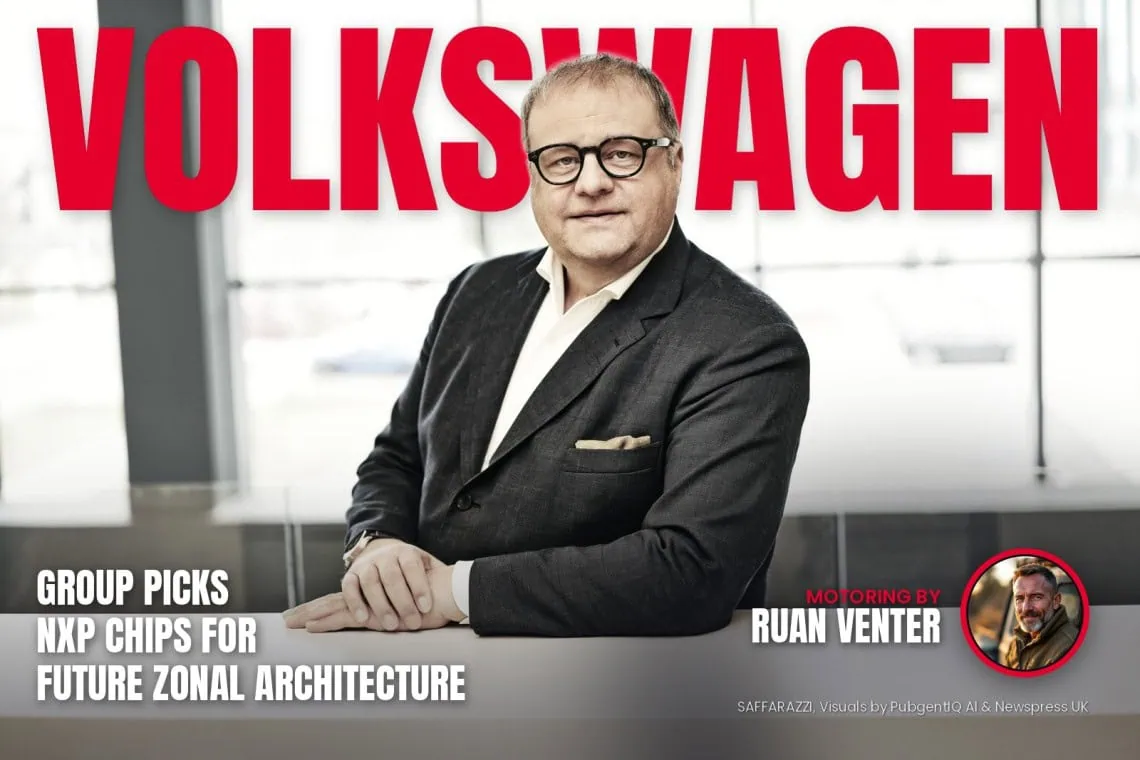

- Volkswagen Group and NXP agree strategic partnership.
- NXP S32K5 microcontrollers chosen for zonal control.
- Architecture developed by RV Tech joint venture.
- Common chips across all Group brands.
- First vehicle planned for 2027.
NXP Semiconductors has been selected as a strategic technology partner by Volkswagen Group, expanding the cooperation between the two companies in automotive semiconductor technology. Under the agreement, NXP’s S32K5 family of microcontrollers (MCUs) is intended to serve as a common building block of the carmaker’s future software-defined vehicle (SDV) architecture, supporting zonal control across all brands and vehicle segments.
Why Volkswagen Group is moving to zonal control
Modern vehicles must support a growing number of digital functions. Handling them through separate electronic control units (ECUs) increases complexity in development and parts management and limits scalability. A zonal layout tackles this by using powerful microcontrollers to consolidate multiple functions into fewer ECUs.
High-performance processors provide central computing power for AI-enabled functions such as automated driving and advanced infotainment. Alongside them, the S32K5 chips act as the core processors of the zonal controllers. They connect sensors and actuators, collect and process data from specific areas of the vehicle, and manage lighting, body, comfort, chassis and safety systems.
NXP S32K5 and the RV Tech architecture
Functions that previously required separate chips and ECUs can be consolidated within these controllers, reducing hardware complexity. The microcontrollers will underpin the zonal SDV architecture developed by Rivian and Volkswagen Group Technologies, LLC (RV Tech), the joint venture between Volkswagen Group and Rivian. That architecture is intended for both companies’ vehicles while still allowing brand-specific features.
Lars Reger, Executive Vice President and CTO at NXP Semiconductors, said the S32K5 “is built for safe real-time compute, fast and secure OTA updates and the consolidation of functions”.
Semiconductor strategy and Group Target Picture 2030
The deal forms part of a broader semiconductor strategy built on direct, long-term partnerships with chip companies, aimed at strengthening supply resilience and jointly shaping technologies for future vehicle generations. It supports the Group Target Picture 2030, which seeks synergies across brands and regions.
Karsten Schnake, the board member responsible for Procurement at the Volkswagen brand, said the partnership shows the Group “defining our technology needs early, leveraging our scale across brands and creating greater long-term planning certainty for both sides”.
When the first vehicle arrives
According to Werner Tietz, responsible for Group Research and Development, harmonising key technologies will reduce complexity and allow vehicles to be enhanced continuously throughout their lifecycle. The first vehicle featuring the new architecture is planned for 2027.
Supplied by Newspress UK (Volkswagen Group)
This story is based on aggregated news, press release(s) or other sources and was prepared with the help of AI tools, which can make mistakes. Prices, specifications, general information and availability may change, so confirm the details with the manufacturer, other news sources or a dealer.
Enjoyed this story? We need your help.
Add Saffarazzi as a preferred source. You’ll see more of our stories on Google, and you’ll help us grow.