

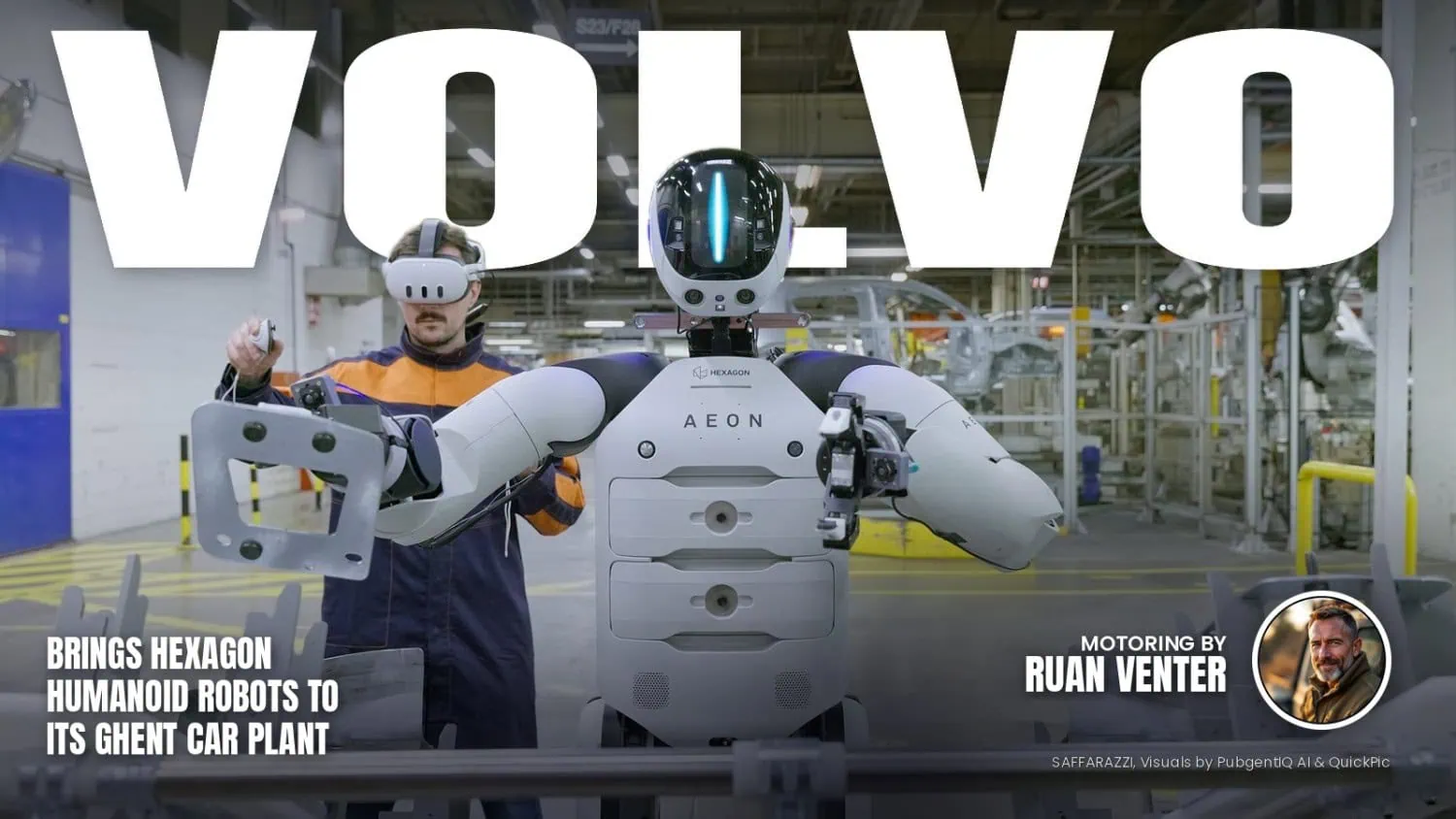
- Humanoid robots training at Volvo’s Ghent plant.
- AEON robots developed by Hexagon Robotics.
- 1.65 metres tall, 60 kilograms.
- Factory pilot planned for first half 2027.
- Real production use targeted from mid-2027.
Repetitive and ergonomically challenging work on the factory floor is the target of a new programme at Volvo Cars, which is training and validating AEON humanoid robots on real industrial tasks in Ghent, Belgium. The aim is to support employees with jobs that are physically demanding.
Ghent is the first Volvo Cars plant to try humanoid robots. They are currently learning alongside employees and existing automation ahead of a factory pilot in 2027, as part of the carmaker’s wider investment in advanced manufacturing. The stated goal is safer, more flexible and more efficient manufacturing.
How Volvo trains the AEON robots
Volvo Cars’ own team is doing the training in close collaboration with the Robotics division of Swedish technology group Hexagon. The method is imitation learning, in which the robot picks up a task by copying how it is done. Its first job is placing components into two fixtures with high precision.
As each step is proven, the work will gradually become harder. Planned stages include handling multiple parts, moving around the production area and interacting with the plant’s automated systems.
Why Volvo chose a humanoid shape
Robot arms and other fixed automation have long been part of car manufacturing and handle stable, highly repetitive work in a set location well. Some ergonomically challenging tasks, however, need a level of flexibility that fixed arms cannot offer.
“AEON’s humanoid design means it can fit into our production as it is today, alongside our teams and existing automation,” says Magnus Nilsson, Chief Manufacturing Officer at Volvo Cars.
AEON robot size, speed and payload
Standing 1.65 metres tall and weighing 60 kilograms, the robot uses cameras and sensors to capture its surroundings and handle parts precisely. Instead of feet it moves on wheels, reaching up to 2.4 metres per second, about the pace of a light jog, and it can carry 10 kilograms. AEON is designed as a multi-purpose platform that can be trained for different industrial tasks.
Ghent pilot and production timeline
The current training lays the groundwork for a factory pilot in the first half of 2027, when more AEON units will arrive in Ghent to take on a wider range of tasks. Volvo Cars aims to use the robots in real production from mid-2027. Arnaud Robert, President of Hexagon Robotics, says working closely with Volvo Cars’ teams allows the company to ensure AEON performs real-world tasks that support the manufacturing process.
Sourced from QuickPic (Volvo Car)
This story is based on aggregated news, press release(s) or other sources and was prepared with the help of AI tools, which can make mistakes. Prices, specifications, general information and availability may change, so confirm the details with the manufacturer, other news sources or a dealer.
Enjoyed this story? We need your help.
Add Saffarazzi as a preferred source. You’ll see more of our stories on Google, and you’ll help us grow.