

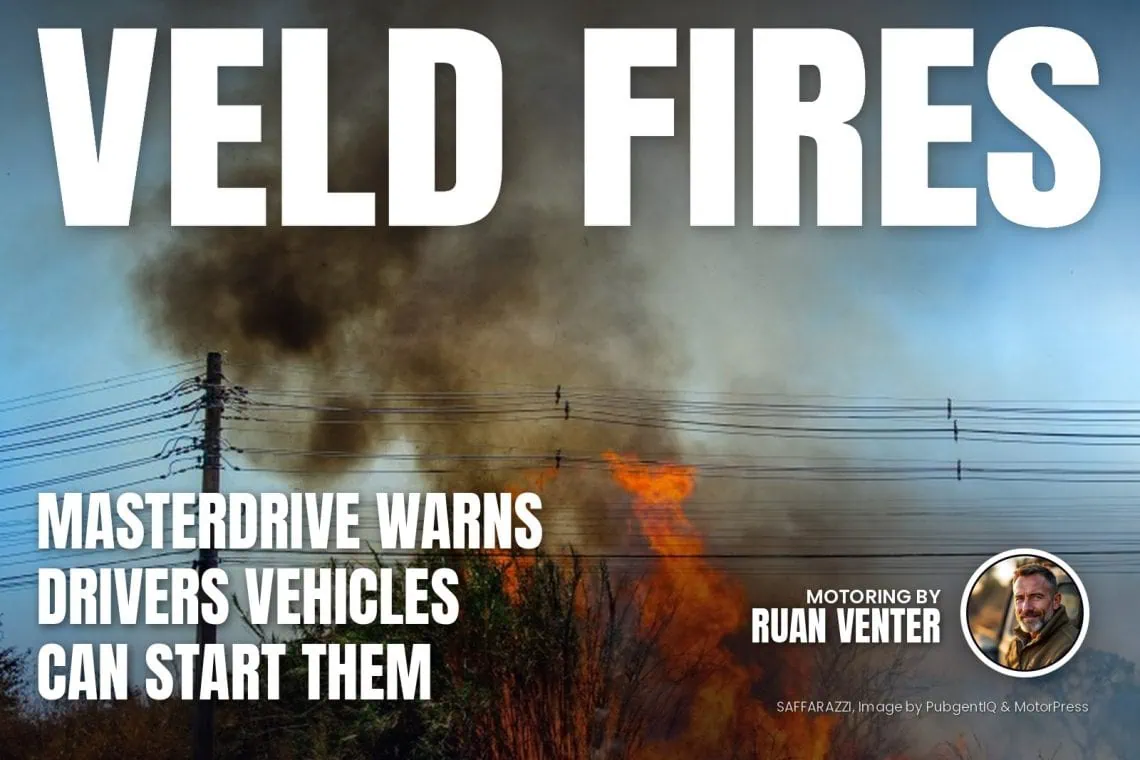

- Dry winter raises veld fire risk for drivers.
- Catalytic converters can exceed 648⁰ Celsius.
- Park on tar, not dry grass.
- Slow down or turn back in smoke.
- Stay inside the vehicle while fire passes.
After a dry winter across most of the country and rising temperatures, MasterDrive South Africa has warned that motorists face a real risk from veld fires this season, and that their own vehicles can start them. A hot exhaust or a failing catalytic converter can be enough to set dry grass alight.
How a vehicle can start a veld fire
A catalytic converter can reach temperatures of over 648⁰ Celsius within minutes of driving, and dry grass can ignite at temperatures far lower than that. Parking or idling over dry vegetation, even briefly, allows that heat to transfer straight into the grass beneath the vehicle. A smoulder can begin and remain unnoticeable until after the driver has left.
Eugene Herbert, CEO of MasterDrive, said many drivers overlook their own vehicle as a source. “A build-up of dry grass around an exhaust or a converter that is starting to fail can be just as dangerous, and the driver may be kilometres away before it becomes visible.”
Habits that reduce veld fire risk
MasterDrive advises drivers to choose tar or paved surfaces over dry grass or verges when stopping, which removes one of the biggest risk factors. Regular professional checks for exhaust leaks, loose heat shields and any build-up of dry material around the exhaust system can help catch problems early.
Tyres and brakes also need attention, since a dragging brake or an underinflated tyre running hot can generate enough heat to ignite dry ground.
Driving through smoke from a veld fire
Drivers can also be caught in a fire that started elsewhere. According to MasterDrive, the instinct to outrun thick smoke or push through it faster is where most of the danger lies, as visibility can drop to almost nothing in seconds. Drivers who continue at normal or higher speed risk colliding with vehicles or obstacles, or running off the road.
Drivers should slow down immediately if visibility drops and, if it is near zero, turn back and find another route. If stopping becomes necessary, they should look for a clearing with low vegetation, switch off the ignition and keep hazard lights on.
Staying safe inside the vehicle
Staying inside the vehicle offers more protection than moving on foot, with windows and vents kept closed while the fire passes. If conditions inside become unbearable, ground that is already burnt is safer than unburnt vegetation. “The safest response is to always stay calm, stay low, and let the fire pass rather than trying to beat it,” said Herbert.
Supplied by MotorPress (Samantha Greathead, MasterDrive South Africa)
This story is based on aggregated news, press release(s) or other sources and was prepared with the help of AI tools, which can make mistakes. Prices, specifications, general information and availability may change, so confirm the details with the manufacturer, other news sources or a dealer.